
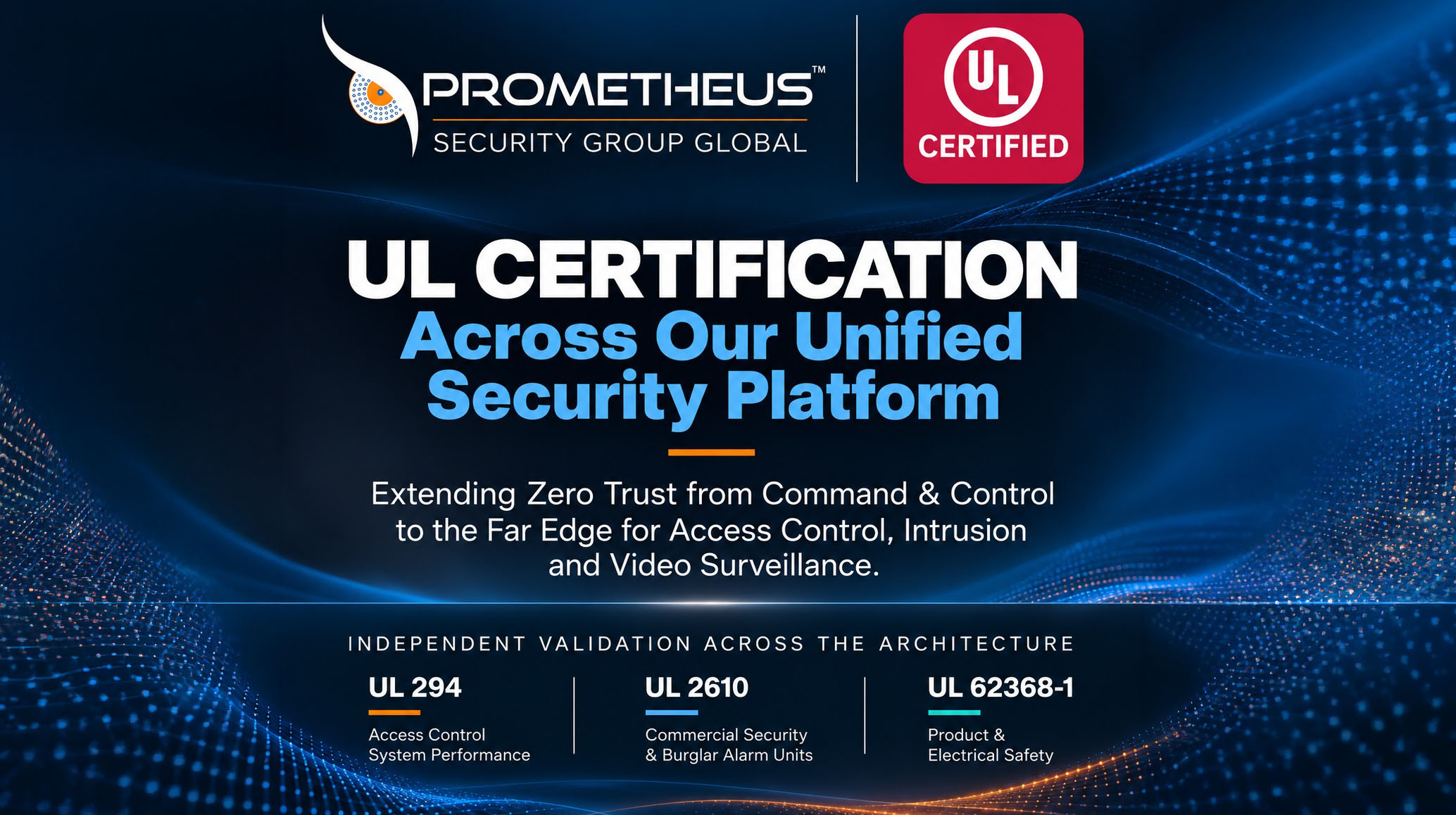
UL listings span PSG’s Zero Trust architecture from far-edge devices through command-and-control software
AUSTIN, Texas — October 21, 2026 — Prometheus Security Group Global (PSG), a provider of Zero Trust physical security technology, today announced UL certifications and listings spanning key components of its physical security platform, including its DESI digitally encrypted security interfaces, Universal Field Panel (UFP) hardware, and LINX Predator Elite software.
The certifications validate PSG technology across access control, commercial premises security and product safety requirements, providing independent confirmation of the performance, reliability and safety of technology spanning the physical security data path—from sensors, door hardware and other devices generating events at the far edge through the hardware and software processing, monitoring and acting on those events. For PSG, the physical security data path is a cybersecurity boundary: if the originating device or signal cannot be trusted, neither can the data entering upstream security, automation and super intelligence systems.
“Achieving UL certification across our platform is an important milestone for PSG and for our customers,” said Rick Gross, CEO and co-founder of PSG. “We built our architecture around the premise that trust must begin at the source—including the physical devices at Purdue Levels 0 and 1. By extending Zero Trust cybersecurity principles to physical security devices at the far edge, we establish verification in the data before it enters the broader security ecosystem. These certifications provide additional independent validation of the performance and reliability of that architecture.”
Independent Validation Across Access Control, Intrusion and Product Safety
PSG technology was evaluated to UL standards covering distinct areas of physical security performance and safety. PSG’s certifications and listings can be independently verified through UL Solutions’ Product iQ database by searching LDIA Holdings dba Prometheus Security Group Global or UL File No. BP21344.
UL 294 – Access Control System Performance
UL evaluated functional performance across critical areas including destructive attack, line security, endurance and standby power. Testing validates the ability of the equipment to reliably support physical access applications, resist physical and electrical tampering and continue functioning during power interruptions.
PSG Product iQ Listing — ALVY.BP21344, Access Control System Units
Security Command Center (SCC); DESI-IN, DESI-R and DESI-S; UFP-EM16; UFP-EM8; UFP-GW; and PM4.
UL 2610 – Commercial Security and Burglar Alarm Units
UL evaluated capabilities including line monitoring, signal transmission integrity, resistance to signal spoofing and fault reporting. Testing also evaluates communications against interception, replay attacks and line tampering, providing validation of the operational reliability required for commercial alarm and threat-monitoring applications.
PSG Product iQ Listings:
AMQE.BP21344 – Commercial Premises Security Alarm Units and Systems: Security Command Center (SCC); DESI-IN, DESI-R and DESI-S; UFP-EM16; UFP-EM8; UFP-GW; and PM4.
UZSA.BP21344 – Software Receivers: LINX Predator Elite.
UL 62368-1 – Product and Electrical Safety
PSG hardware was evaluated using Hazard-Based Safety Engineering principles, including protection against electrical shock, fire and thermal hazards, power-related risks and mechanical hazards.
Together, these certifications and listings span PSG’s architecture from far-edge devices and control hardware through command-and-control software—reinforcing PSG’s approach to establishing strong cryptographic identity at the source and maintaining it throughout the security data chain. As unified cyber-physical systems increasingly rely on automation, analytics and super intelligence, the integrity of the data entering those systems becomes increasingly critical.
“PSG technology was originally engineered for some of the nation’s highest-security environments, where reliability, resilience and the repudiation of every security event are critical,” said Jeremy Freeze-Skret, Vice President of Engineering and co-founder at PSG. “That same engineering foundation that is available to organizations protecting critical infrastructure and other high-security environments is now available to a broader commercial audience. These UL certifications provide additional independent validation of the performance and resilience built into the platform.”
Supporting High-Security and Critical Infrastructure Deployments
For security integrators, consultants and end users, UL certification simplifies product selection and support Authority Having Jurisdiction (AHJ) review for projects requiring or preferring UL-listed security equipment. This is particularly relevant in government, critical infrastructure and other high-security environments where equipment may be required to meet defined UL requirements.
Zero Trust Begins at the Far Edge
Traditional cybersecurity strategies focus primarily on users, networks, applications and data. PSG extends those Zero Trust principles to the physical devices where Identity of Things (IDoT) security events originate—helping bridge a trust gap between the cyber and physical security domains.
PSG technology establishes cryptographic device identity, authenticates communications and verifies security signals from source to decision. Rather than requiring organizations to replace existing sensors, readers, locks and wiring to implement modern cybersecurity, PSG’s architecture is designed to unify by bringing device identification and authentication to existing physical security environments.
As physical security becomes increasingly automated and AI-driven, establishing strong identity at the source becomes even more important. AI, analytics and automated systems can only make reliable decisions when the data informing those decisions can be authenticated and verified.
About Prometheus Security Group Global
Prometheus Security Group Global (PSG) develops advanced physical security technology designed to extend Zero Trust principles to the far edge. PSG establishes trusted device identity, authenticated communications and verified security data from field devices through command-and-control systems, helping organizations protect critical infrastructure while leveraging existing security investments. PSG technology supports government, defense, utilities, critical infrastructure and enterprise environments and integrates with existing security infrastructure without requiring wholesale replacement.
For more information, visit www.psgglobal.net
Contact Information
Bobbie Ferraro
VP, Marketing & Critical Infrastructure Partners
310.800.5252,
Bobbie.Ferraro@psgglobal.net