
A&E Program

Zero Trust, specified from the first drawing

PSG supports architects and engineers who write physical security into the design: specifications on every product page, A&E resources where approved, and engineers behind them.

Security from the start

Designed in from day one, not bolted on later

In a greenfield design, architects and engineers have an advantage a brownfield site lacks: the chance to build Zero Trust in from the start. Treated as a design principle rather than an added burden, it prevents rework and costly retrofits later.

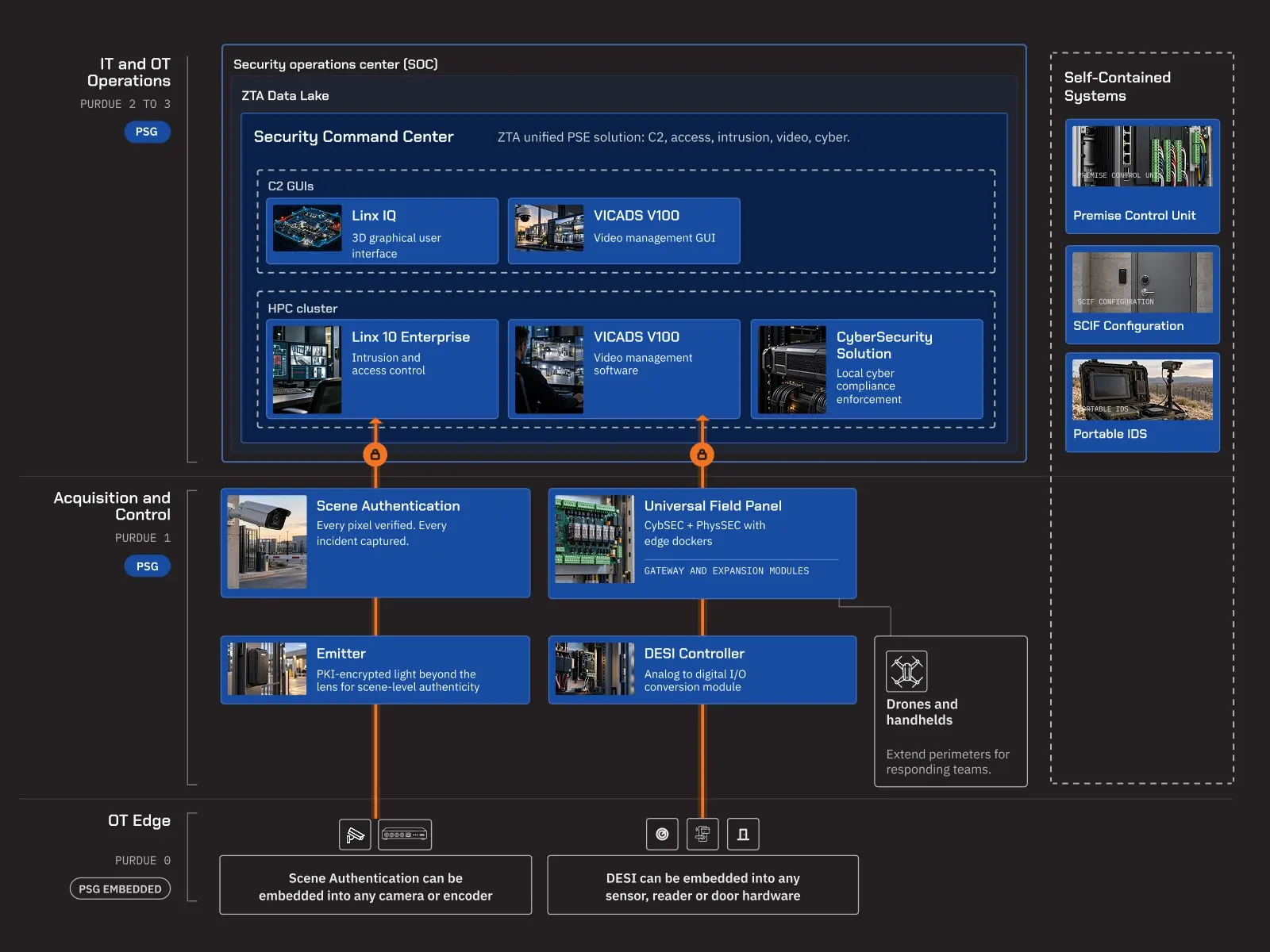
PSG's reference architecture is built for that moment. DESI modules fit nearly any installation, and one pair of wires per door cuts cabling by more than half. Scene Authentication™ can be preloaded on new cameras with emitters in the design, so video is authenticated without retrofit cost. Specified this way, a system is lower cost to secure, faster to certify and resilient for the long term.
Download the ZTA Guide
PSG Zero Trust Architecture from IT and OT Operations down to the OT Edge

What you get

Everything a specification needs, on the product page

A&E resources live on the product page they describe, so each document stays tied to the product it specifies.

Register

Register as a specifier with PSG

Tell us your firm, role and what you specify so an engineer can support your project. Registration records your interest in controlled documents.

Your details are used to support your work with PSG and are handled under the PSG Privacy Policy.

Questions specifiers ask

Before you write PSG into a specification

Does PSG replace what is already installed?

No. PSG is embedded beneath the physical security, industrial control and building automation platforms a site already runs, and strengthens them rather than replacing them. On existing circuits the DESI Controller replaces the end-of-line resistor while wiring, conduit, sensors and door hardware stay in place, so a specification can bring cryptographic trust to the far edge without a rip-and-replace scope.

Where has PSG's architecture been proven?

PSG's architecture was developed for U.S. Air Force Protection Level 1 Nuclear (PL1N) environments and is deployed in PL1N programs under the DoD and DOE. VICADS® V100 carries federal certifications for performance at Protection Levels 1 to 4 and Risk Management Framework Authority to Operate. Certifications for each product are listed on its product page.

How do I cite PSG in a CSI specification?

Each product page lists the CSI section PSG assigns to the product, beside its data sheet and A&E resources. Where a guide specification is approved it is on the page; where it is not yet approved, ask, and a PSG systems engineer will support the section you are writing. Division cross-reference pages are planned for a later phase.

How much wiring does a PSG design need?

Less than a conventional design. With DESI, a door's request to exit, lock control, door position and reader or lock tamper signals travel over a single pair of wires to the panel, reducing cabling by more than half. Each Universal Field Panel™ supports up to 128 inputs, 64 outputs and 16 readers, which lowers panel count, terminations and the cost per door and per input.

Does Scene Authentication need cameras?

Yes. Scene Authentication is an open architecture with SDK and API integration for any third-party camera or video management system, and it can be deployed over plug-in architectures on cameras that support on-device applications. In a new design the software can be preloaded on the cameras and the emitters placed in the field of view, so authenticity is enforced from installation day one.

Specifying a project? Start with a systems engineer.

Send us the section you are writing or the drawings you are working from. Visit with a PSG systems engineer about which products fit and which documents you need.